
Residential solar, sized to your actual usage.
A system sized to twelve months of your real consumption, designed and installed by the same two people who own the company. You get the production model and the assumptions before you commit to anything.
Most residential solar quotes arrive as a monthly payment and a percentage saved. Ours arrives as a system size, a modeled production number, and the assumptions underneath both, because the payment is meaningless if the assumptions are wrong.
One thing up front, because it changes the math. The federal tax credit for residential solar has ended. Businesses can still claim it; homeowners cannot. Anyone quoting you a residential system that still nets out a 30% credit is quoting you a number that no longer exists, and you should treat the rest of that proposal with the same suspicion. Where incentives actually stand in 2026 covers what is and is not still available.
What we look at
-
Twelve months of usage, before anything else
Not your last bill, and not a square-footage rule of thumb. A full year, because Michigan sizes your system against your own consumption and because summer and winter look nothing alike here. That single input sets both the economics and the legal ceiling, which is why we ask for it before we will quote you a number.
-
Roof condition and remaining life
The array should last twenty five years. If your shingles have eight left, the honest answer is to reroof first, not to build on top of a problem and pay twice to take the array off and put it back. We check age and condition before design and will tell you when the roof is the project.
-
Shading, honestly assessed
A tree that shades one corner at 4pm in October costs you less than most people fear, and a tree that shades the middle of the array at noon costs more. We model it rather than eyeball it. Where shading is real, module-level electronics limit the damage to the affected modules instead of dragging a whole string down.
-
Your electrical panel
Solar has to land somewhere. Panel capacity, main breaker rating, and busbar limits decide whether the interconnection is straightforward or needs a service upgrade. Finding that out during design is a line item. Finding it out on install day is a surprise, and we would rather not hand you one.
-
Whether battery actually earns its place
A battery buys you backup during an outage and some control over when you use what you generate. It does not usually pay for itself on rate arbitrage in Michigan. If outages are frequent where you live or you have something in the house that cannot go down, it is worth it. If not, we will say so.
-
What you are planning next
An EV, a heat pump, a shop, an addition, or a kid moving home all change your consumption, and consumption sets your size. It is far cheaper to plan the array around the load you are about to add than to come back and extend it later.
Design, permit, install, monitor.
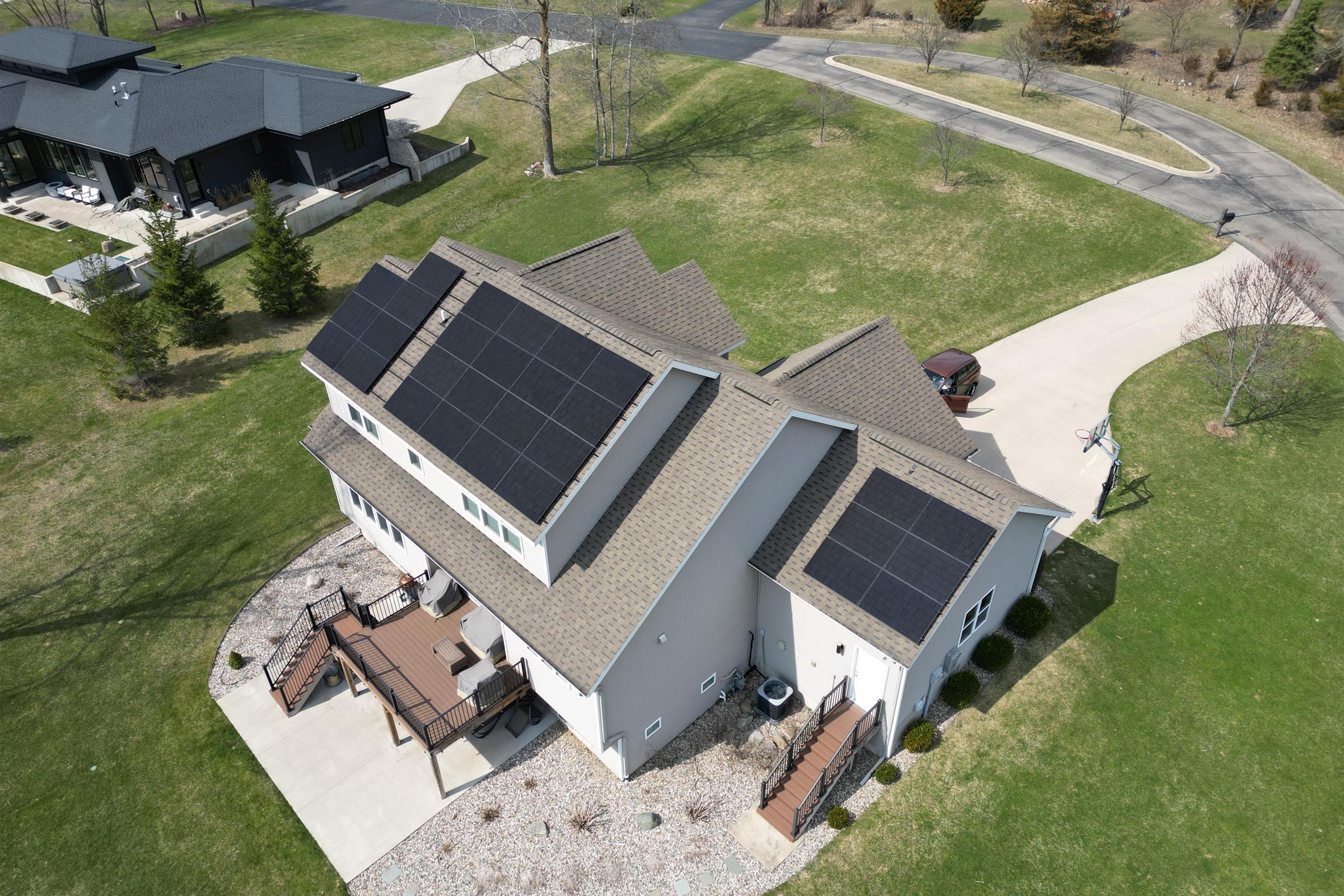
We survey the roof, model production against your twelve months, and send you the design with the equipment named by make and model. If you go ahead, we pull the building permit, file the interconnection application with your utility, schedule the inspection, and commission the system.
Every module is monitored individually, so a single underperforming panel is something we can see from here rather than something you discover on a bill three months later.
What we install on
- Asphalt shingle
- Standing seam metal
- Exposed fastener metal
- Ground mount
- Detached garage or outbuilding
- Multi-plane and dormered roofs
- Barns and pole buildings
- New construction, designed in
Paying for it
Cash, a home equity product, or Michigan Saves financing, which is the state-backed program most of our residential customers use. Which one you choose is not a side detail — it changes which system size makes sense, because a loan payment competes against the bill you are trying to replace. Ask about it early rather than after the design is fixed.
What you get back
- System size and layout on your actual roof
- Modeled annual production, month by month
- The equipment list by make and model
- How it lines up against your current bill, at your utility's rate
- The assumptions behind all of it, in writing
If it does not pencil out on your roof, we will tell you that, and it will not cost you anything to have found out. We would rather lose a sale than sell you a system that does not make sense.
Related reading: what solar actually costs, how Michigan credits exported energy, and what a Michigan array does in winter.
Send us a bill.
Twelve months of usage is all we need to model your system properly. No appointment required to get a price.